Wednesday, October 12, 2016

Boston Baked Beans


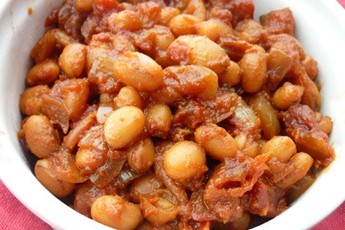
Shameful Omission:  We forgot to take a final picture.  Here's a picture that looks really similar from lovefood.com.


If you recall our New Year's recipe of Black-Eyed Peas (LINK), this will be pretty similar.  It's a slow-cooking dish with simple ingredients that meld into magic.  The Boston Baked variety highlights the classic American flavors of molasses, ketchup, and brown sugar.

Here's the recipe:
1 pound Navy beans or kidney beans
1/3 cup molasses
1/3 cup brown sugar
1/4 cup ketchup
1/2 pound salt pork
2 onions
4-6 cloves of garlic
1/2 teaspoon of ground mustard
1 tablespoon of cumin
1 tablespoon of paprika
2 teaspoons of salt
2 teaspoons of black pepper
a few dashes of Worcestershire sauce

Soak the beans overnight in a gigantic bowl.


Start by browning the outside of the salt pork.


I added some cumin for flavor (optional).

Chop the garlic and slice the onions.


Pull the browned salt pork, and start cooking down the onions in the pork drippings.


Chop the salt pork into 3/8" x 3/8"


Add the garlic and salt pork when the onions start to soften.


Add all of the remaining ingredients (ketchup, molasses, brown sugar, Worcestershire, seasonings).


Drain the beans and add them.

Fill with water to cover the beans and mix thoroughly.

Bring to a boil and simmer until the beans are tender and the sauce has thickened.  You're allowed to over-cook these, compared to black-eyed peas and red beans.  It should take a couple hours.


The final product should be soft, syrupy, and flavorful.  (shame!  borrowed picture)

Wednesday, October 5, 2016

Creole Jambalaya


An important distinction to make is Creole vs Cajun.  Cajun comes from the term "Acadiana" which describes the central and southern Louisiana areas and its culture.  Creole refers to the people and culture that blended the French colonial culture with African, Caribbean, and native people.

Cajun cuisine uses a limited set of ingredients, which were easily accessible to the area.  Ingredients often traveled along the Missisippi river and local roads.  It's generally considered "country food."

Creole cuisine has access to a wider pantry, due to the trading through the port of New Orleans.  The people brought a "big city" spin on the classic Cajun dishes.  Since this jambalaya uses tomatoes, it's considered Creole (although my family grew tomatoes in Bossier City, LA).


This recipe will be very familiar to those who are playing along at home (LINK to Gumbo).   Instead of being a soup, it's a rice-based dish with similar preparation and ingredients.  The recipe comes from the Junior League of Lake Charles and their book "Pirate's Pantry."

We begin by chopping the mirepoix (celery, onion, and bell pepper) with a couple cloves of garlic.


Slice the sausage and allow the shrimp to thaw.


Start the roux with canola oil and flour.


Once the roux is "blonde" drop in the sausage.


After a couple minutes of browning, drop in the bell pepper (since it takes longer to cook).


After a couple minutes, drop in the onion and celery.


After a couple minutes, drop in the garlic and keep stirring to prevent burned garlic.


If you're using the Creole recipe, add diced tomatoes and some water to "soupy" consistency.

Add your favorite spice blend.  Generally, jambalaya is not prepared as spicy as gumbo, but the world is your spice cabinet.


Let the sausage and veggie mixture stew.   Add the spice blend, then peel the shrimp.

Drop in the shrimp and rice.

Bring to a boil and allow to simmer until the rice has absorbed all of the liquid.


The final product should look like this:


Remove the bay leaves and serve with some green onions on top.


Wednesday, September 28, 2016

Chili Cook-Off R&D


As data scientists, the obvious first step in preparation for a friendly Chili Cook-Off is to conduct a survey.  Hypothetically, we should be able to optimize the recipe by robustly maximizing an estimator of vote probability.

The feedback from coworkers indicate:
 - Meat is generally expected.
 - Texas-style meat + gravy isn't enough.
 - Spices should be strong, but not hot.
 - Veggies and beans are acceptable in modest quantities.

Next, we reviewed previous chili championship recipes:

Competition chili is typically meat and gravy (which isn't enough)... but the flavors are well-proven winners.  This will serve as a roadmap for our chili, with a healthy dose of  veggies and/or beans.

All recipes begin with 3-4 lbs of beef (ground or finely chopped tri-tip/sirloin).  Augment with the appropriate amount of fat to fry the bottom layer.


Brown the meat.

We used ground beef and needed to remove some fat afterwards.  The meat should be lightly coated without much on the bottom of the pan.


Our gravy will use a combination of:
 - 1 can of tomato sauce (spicy or regular)
 - 1/2 box of beef stock
 - 6-8 oz of V8 juice

Bring the mixture to a boil and stir.

Next, we develop the flavor package.  Here, we used:
 - 1 tbsp Mexican chili powder
 - 1 tbsp regular chili powder
 - 1 tbsp paprika
 - 1 tbsp garlic powder
 - 1 tbsp cumin
 - 1 tbsp ground black pepper
 - 3 tbsp onion powder
 - 1/2 tbsp salt
 - 2 bay leaves


If you want more spice, slice open a jalapeno or two.  Drop them in the pot.

Bring to a boil and simmer for 1 - 2 hours.


After removing the bay leaves and jalapenos, mix in cornstarch until you reach the desired gravy viscosity.  With a few minutes of simmering, this is Variant #1:  Texas-Style Chili.

Variant #2:  Bean Chili

Begin with a can of beans.

Mix in the beef + gravy mixture and simmer for atleast 1 hour.  The flavor will transfer to the beans.

Variant #3:  Mushrooms & Zucchini

Cook down some chopped mushrooms and zucchini.  Once the veggies have softened, mix in the beef + gravy mixture and simmer for atleast 30 minutes.

Serve with cornbread, polenta, rice, or as-is.

As predicted, Variant #2 & #3 received positive feedback from the taste-testers.  Future experiments might include turkey, bell peppers, and red beans.  Since our target is not "true" competition chili, it may be worthwhile to convert the garlic/onion from powder to fresh veggies.

Wednesday, September 21, 2016

2016 Single Cell Genomics Conference

Last week I attended the 2016 Single Cell Genomics (SCG) Conference at the Wellcome Genome Campus in Hinxton, Cambridge, UK. This conference started in 2013 at the Weizmann Institute of Science, moved to the Karolina Institute in 2014, and was most recently held in the Hubrecht Institute in 2015. A PDF of the program is located here and my notes on the talks including links to various methods, publications and twitter accounts for the speakers are on GitHub. You could follow the tweets online using the twitter hashtag of #SCGen16.
This was a fantastic conference that I would highly suggest to anyone working in the single cell genomics world. Some random take aways of things I noticed compared to other conferences I recently attended were:

1. I was bummed that many of the speakers did not have their talks streamed. As I attended in person, I was fortunate enough to see all the talks, but apparently there was a pretty big waitlist for this conference. The organizers decided to offer a stream for a reduced registration fee with the caveat that not all talks may be streamed.  I assume this was primarily driven by the fact that many presenters discussed unpublished work, but still I'm sure this was frustrating for the waitlisted individuals who were not able to attend in person.


2. Similar to #1, almost none of the speakers made their slides available online (even the ones that agreed to have their talk streamed). I recently attend the Joint Statistical Meetings in Chicago, IL July 31-Aug 3 this year where Karl Broman kept a great list of links to talks from speakers at JSM 2016 (I also kept my own notes). I was really hoping to be able to go back and review slides after the conference ended, but to my knowledge, I was the only one to post slides. To be fair, JSM is significantly larger than the single-cell genomics conference, but I was expecting at least some speakers to post their slides online. I gave a talk on progress in deal with batch effects and biases in single-cell RNA-seq data.

3. The power of the pre-print! Much of the work discussed was either published or in pre-prints.  Sarah Teichmann presented work on the sensitivity, specificity and accuracy of different scRNA-seq protocols using ERCC spike-ins and has a pre-print available on bioRxiv. She humorously pointed out a sense of relief after Lior Pachter sounding positive about the paper by tweeting it.

4. As someone who's very much interested in promoting women in STEM, I was interested to see the ratio of female to male speakers and attendees at the conference.  Though there were fewer women, I was excited to see such prominent women showcasing their work, but as always, there is room for improvement. Sean Davis from NCI has a single cell GitHub repository, which contains list of people (males and females) working in this field. It would be great place to start for looking for additional female speakers.

5. Finally, there were many fantastic biological talks and a lesser number of equally wonderful methods talks, but a few of my favorite methods talks included:


6. Lack of twitter presence. I don't believe having a twitter presence is relevant to having good research in genomics, but I have noticed a large community of people who work in genomics on twitter.  Therefore, it was interesting to me that so few of the speakers at this conference had a presence on twitter. Just for my own curiosity, I did a quick analysis of the tweets from there conference [code in RMarkdown] to find out the top 50 most tweeted words at the conference (after removing the #scgen16 hashtag).


If you want to know more about some of the talks, I have some notes here on GitHub.

Thursday, September 15, 2016

Ahi Tuna Poke


ALOHA!
2 years ago, we went to Kauai, Hawaii for our honeymoon.  Besides the normal tourist checklist of surfing, lū'aus, and plantation tours... we sought out the best local foods.  Fish tacos were consumed daily, and we sampled all of the traditional favorites (poi, kukui, pineapple, avocados. lomi-lomi salmon, and kālua pork),  

One of our favorite local foods was poke!  It's a great blend of simplicity and bold flavors.  Let's dive into the recipe:

2 - 4 tuna steaks (1 pound is usually good for 4-6 servings)
1/4 - 1/2 sweet onion (Vidalia or Maui)
2-3 green onions
1 jalapeno (seeded)
4 tablespoons of Tamari soy sauce
1 tablespoon of sesame oil
1 teaspoon of red pepper flakes
2 tablespoons of sesame seeds

Raw Fish Alert!
(believe it or not) You can get tuna at many supermarkets that is suitable for eating raw.  If you don't have access to a top-tier fishmonger like the ones on the harbors of Boston and New York, it's best to get your fish frozen and vacuum-packed at the source (the fishing boat).  Sometimes the local fishmonger will have access to some #2 or #3 grade tuna, but you'll want a tracking report to ensure that your fish never got above freezing.

We went with some legit steaks from a quality local supermarket.

Allow them to thaw slightly, but still firm.  Open the packages.


Chop into bite-sized (1/2") cubes.


Organize the sauce and veggies.


Slice the jalapeno paper-thin (1/16"), the sweet onion super-thin (1/8"), and green onion thin (1/4"). 


Combine the veggies and sauce ingredients.


Combine with the cubed Ahi.


Look closely.  There's a layer of plastic wrap pressed on the poke, and a second layer over the bowl.  Store for atleast an hour, but 4-6 will only help get the flavors to mingle.

It's best to eat it with short-grain rice (with sushi seasoning, if you dare)... but we enjoyed it as-is.

Wednesday, August 3, 2016

Data Science Initiative at Rice University

There are many Masters in Data Science programs that have been developed over the last few years including at universities, massive open online courses (MOOCs) such as the Data Science Specialization on Coursera or if you're really self motivated an Open Source Data Science Masters curriculum that you can work through at your own pace. A few weeks ago I was happy to see my graduate school alma mater (Rice University in Houston, TX) announced that it was awarded a $1.4 million dollar grant from the NSF to start a Data Science program between faculty in the Statistics and Computer Science departments. The money will be used to develop courses by faculty in both departments and to allow undergraduate students, graduate students and postdoctoral researchers to take courses and complete research projects. This comes after the university announced last fall a $43 million dollar investment of establishing a world-class program in data science. I look forward to seeing exciting things from these two initiatives!

Congrats to Rice!